India and Sweden Enter a Strategic Decade
A Strategic Partnership Built on Strong Foundations
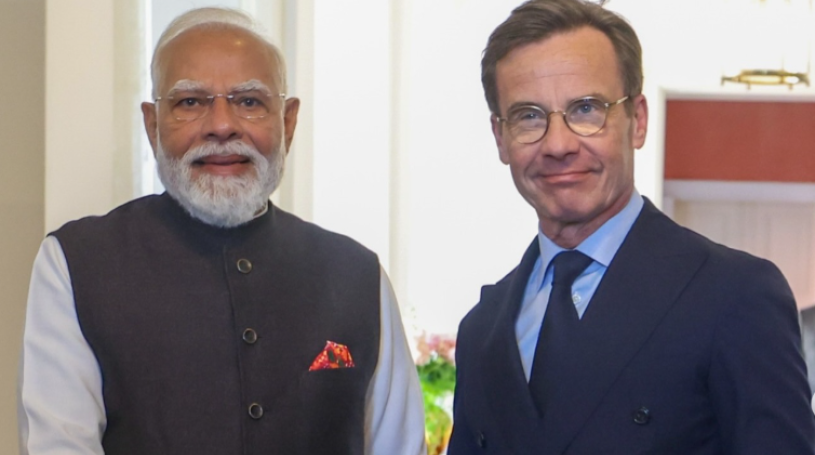
Prime Minister Narendra Modi’s visit to Gothenburg and the decision to elevate India-Sweden relations to a Strategic Partnership marks an important turning point in the evolution of bilateral ties. The significance lies less in the announcements and more in the institutional framework that will guide cooperation over the coming decade.
Many strategic partnerships begin with political ambition and then struggle to build institutional depth. India and Sweden didn't follow that pattern. The political and business communities moved together from an early stage. The India-Sweden Business Leaders' Roundtable was itself established through a Joint Statement, alongside the first bilateral Action Plan, and the relationship has been sustained by that joint institutional architecture ever since. The Strategic Partnership recognises that foundation and provides a framework to expand it.
The visit took place at a significant moment for India-Europe relations. The conclusion of the India-EU Free Trade Agreement and the adoption of the India-EU Strategic Agenda 2030 have created new opportunities for economic integration between India and Europe. For Sweden, the significance extends beyond improved market access. The FTA creates conditions for deeper participation in one of the world's fastest-growing major economies and opens new possibilities for collaboration across manufacturing, technology, clean energy, and advanced industrial sectors.
Recent analyses by National Board of Trade, and the Federation of Swedish Enterprises, suggest that the FTA could increase Swedish exports to India by more than 20 - 30 per cent respectively, with some sectors expected to see substantially higher growth. Areas such as machinery, advanced manufacturing, automotive components, chemicals, and industrial technologies stand to benefit particularly strongly. These projections provide important context for the ambition announced during the Gothenburg Summit to double bilateral economic exchange within five years. The target is ambitious. Achieving it will require more than tariff reductions. It will depend on investment flows, technology partnerships, research collaboration, talent mobility, and stronger participation from businesses across both economies.
Sweden enters this new phase from a position of considerable strength. Bilateral trade between India and Sweden reached €2.9 Bn in 2025-26. Indian exports to Sweden grew by 8.64% to €1.2 Bn, while imports from Sweden reached €1.7 Bn. Sweden's cumulative foreign direct investment into India stood at €2.8 Bn between April 2000 and December 2025, making Sweden the twenty-first largest contributor to FDI equity inflows into India. These figures reflect a mature commercial relationship, but they only tell part of the story. The more significant development is the institutional ecosystem that has emerged around the relationship.
The Power of Institutions
Institutional frameworks are often discussed in broad terms, yet their practical value lies in reducing uncertainty. Businesses invest when they understand markets, identify trusted partners, and gain confidence in long-term opportunities. Researchers collaborate when mechanisms exist to connect institutions and support joint work. Entrepreneurs expand internationally when networks help them navigate unfamiliar environments. Effective institutions reduce transaction costs, lower information barriers, and create the trust required for long-term commitments.
This process has been unfolding in the India-Sweden relationship for many years. More than 1,200 engagements facilitated through Sweden-India Business Council alone over the past twenty-two years have brought together policymakers, business leaders, researchers, investors, entrepreneurs, and young professionals. Each engagement has strengthened networks, expanded knowledge, and increased familiarity between the two countries. Over time, these interactions have created a foundation that makes deeper cooperation easier and less risky for new participants. This is true for other organisations and their engagements as well. The Strategic Partnership therefore builds upon institutional momentum that already exists rather than attempting to create it from scratch.
The same pattern can be seen across the broader ecosystem of bilateral cooperation. The India-Sweden Business Leaders' Roundtable created by both Prime Ministers in 2016, where CEO's and Chairpersons under the leadership of co-chair Marcus Wallenberg has become a leading platform for business-led cooperation, among other things to advice and suggest policy and regulatory changes to the respective leaders. It collaborates with other initiatives from government to academia to startup sector, making it a true bilateral ecosystem initiative.
Swedish Companies and India’s Transformation
This dynamic helps explain why the Strategic Partnership arrives at an opportune moment. India's role in the global economy has changed significantly over the past decade. India is furthermore increasingly viewed as a major upcoming centre for manufacturing, technology development, digital innovation, clean energy deployment, and industrial growth. Swedish companies are already well positioned within many of these sectors.
Ericsson’s Make in India and Design in India strategies have helped transform its Indian operations into a major manufacturing, research and innovation hub. The company has expanded local production and R&D capabilities in areas including 5G, 6G, AI and cloud technologies, while its partnership with the Telecom Sector Skill Council supports skills development in 5G and emerging digital technologies. ABB has contributed to India’s industrial modernization through electrification, automation and digital technologies while advancing sustainable water management through responsible manufacturing practices, digital water technologies, irrigation infrastructure and community-focused initiatives. Volvo Group has invested in India’s future workforce through STEM education, engineering skills development, and industry–academia collaboration. Its programmes combine practical exposure to emerging technologies with scholarships for female engineering students, helping expand opportunities for the next generation of engineers while strengthening the country’s innovation capacity.
These examples illustrate an important feature of the India-Sweden relationship. Swedish companies have not limited their engagement to market access. They have invested in skills, knowledge transfer, research capabilities, and community development. Such investments generate long-term relationships and create forms of institutional trust that cannot be replicated quickly. They also demonstrate why economic partnerships deepen over time. Companies that build capabilities and relationships within a market become more likely to expand their engagement. Their success encourages others to follow. Growth becomes cumulative.
From Framework to Action
The Joint Action Plan 2026-2030 builds on its predecessor and seeks to accelerate this process. Its four pillars, Strategic Dialogue for Stability and Security, Next-Generation Economic Partnership, Emerging Technologies and Trusted Connectivity, and Shaping Tomorrow Together through cooperation in sustainability, health, resilience, and people-to-people engagement, provide a framework for future cooperation. The plan includes commitments across defence collaboration, cybersecurity, critical minerals, artificial intelligence, quantum technologies, research partnerships, industrial transition, and talent mobility.
The challenge ahead is not identifying areas for cooperation. Sweden and India already cooperate across a broad range of sectors. The challenge is ensuring that the institutions supporting cooperation can operate at greater scale and deliver measurable outcomes.
This is particularly important for small and medium-sized enterprises. Large multinational corporations generally possess the resources required to navigate regulatory systems, identify partners, and establish operations in new markets. Smaller firms often face different constraints. Access to reliable market intelligence, regulatory guidance, financing, local networks, and trusted partners can determine whether international expansion succeeds or fails. If bilateral trade is to grow substantially over the next decade, SMEs must become more active participants in the relationship. Dedicated bilateral mechanisms should therefore focus on simplifying market entry, improving regulatory transparency, facilitating business matchmaking, supporting access to finance, and helping innovative firms scale across borders.
Governments also have an important role to play. Progress in areas such as standards alignment, customs procedures, intellectual property protection, digital regulation, talent mobility, and connectivity will influence how effectively businesses can take advantage of new opportunities created by the FTA and the Strategic Partnership. Institutional platforms can reduce barriers, but some obstacles require policy reform and regulatory cooperation.
The Next Decade of India-Sweden Cooperation
The Gothenburg visit should therefore be viewed as the beginning of a new phase rather than the culmination of an existing one. The business case is already established. The institutional infrastructure exists. The political commitment is now in place. The task ahead is implementation.
Success should be measured against clear outcomes. Bilateral trade should expand beyond current levels. Investment flows should increase in both directions. Research institutions should produce more joint projects and commercial applications. Talent mobility should deepen. SMEs should account for a larger share of bilateral commercial activity. Supply chains should become more integrated across sectors where both countries possess complementary strengths.
The next decade offers an opportunity to convert decades of relationship-building into a deeper economic partnership. Governments have established the framework. Business leaders, researchers, entrepreneurs, universities, and civil society institutions now have the responsibility to translate that framework into tangible results. If that effort succeeds, the Strategic Partnership will be remembered not for the agreements signed in Gothenburg, but for the growth, innovation, and long-term cooperation that followed.